
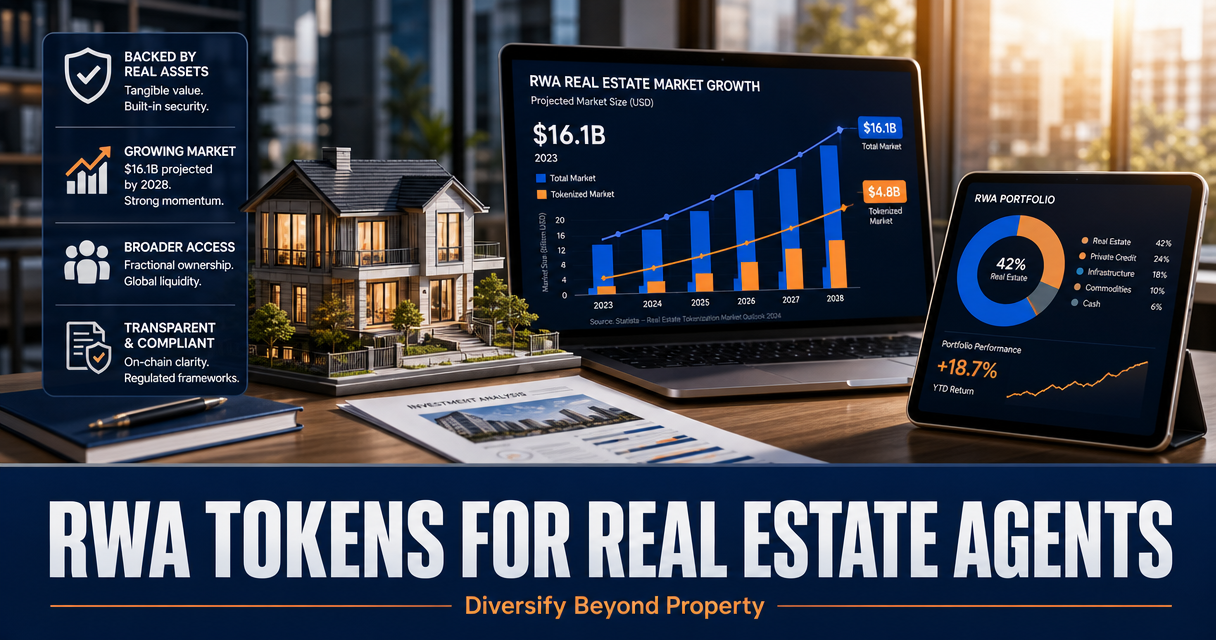

RWA tokens for real estate agents are a natural next step for professionals whose income and personal holdings are already concentrated in one sector — property.
TL;DR: RWA tokens for real estate agents diversifying beyond property means applying the due-diligence instincts agents already have — verify the underlying asset, check the income stream, confirm the exit liquidity — to a different asset class. SmartLeCo’s $SLCT, backed by travel and media business revenue and staked through Gempad, is a useful comparison point: same “real asset behind the token” logic as a rental property behind a deed, different sector and different liquidity profile.
Why RWA Tokens for Real Estate Agents Matter
An agent who already owns rental properties and earns commission from a housing market, per NAR’s 2026 member profile data, is doubly exposed to one sector. RWA tokens backed by unrelated industries — travel, media, energy, logistics — offer a way to diversify without taking on the blind, pure-speculation risk of a meme coin, because the underlying due-diligence questions are structurally similar to evaluating a property deal.
Who This Is For
This is for a real estate agent or broker with meaningful equity or income concentration in property who wants exposure to a different revenue-backed asset class, not someone looking to abandon real estate investing altogether.
How RWA Tokens for Real Estate Agents Work Outside Property
A named underlying business, the way you’d want a named property
Just as you wouldn’t recommend a client buy “some property somewhere,” don’t buy an RWA token whose backing is described only in vague sector terms. SmartLeCo names its backing directly — travel and media business revenue — which is the level of specificity to demand from any RWA token.
An income mechanism you can explain to a client
Agents are used to explaining cap rates and rental yield. RWA staking yield deserves the same scrutiny: SmartLeCo’s staking runs through Gempad, a named third-party platform — ask the same question of any token: who actually operates the yield mechanism, and is it disclosed?
Liquidity that beats real estate, not matches it
One advantage RWA tokens should offer over property is liquidity — if a token takes as long to exit as a house sale, it’s giving up its main structural edge. Check daily trading volume before assuming quick exits.
Correlation to your existing exposure
The whole point of diversifying beyond property is reducing correlation — an RWA token backed by another real-estate-adjacent business (REITs tokenized, property-management revenue) doesn’t diversify much; a token backed by an unrelated sector does.
Regulatory clarity, sector by sector
Real estate has decades of settled regulation; RWA tokenization is still being defined jurisdiction by jurisdiction in 2026. Factor that immaturity into position sizing.
Tax treatment differences from real estate
Property benefits from depreciation and 1031 exchanges; RWA token gains and staking income don’t get the same treatment in most jurisdictions — model the after-tax return separately.
What to Avoid
Avoid over-allocating simply because the due-diligence process feels familiar — familiarity with the analysis method doesn’t reduce the underlying asset’s actual volatility.
Avoid RWA tokens whose only “proof” of backing is a whitepaper claim with no external or on-chain verification.
Avoid ignoring liquidity risk just because the yield looks attractive — a high-yield token you can’t exit is worse than a lower-yield one you can.
Verdict Comparison
| Factor | Rental property | RWA token (e.g. $SLCT) |
|---|---|---|
| Liquidity | Weeks to months to sell | Minutes to hours on a liquid DEX |
| Income mechanism | Rent, cap rate | Staking yield tied to business revenue |
| Tax treatment | Depreciation, 1031 exchange | Capital gains / income, no property benefits |
| Sector correlation to agent’s core business | High | Low, if backing sector differs |
FAQ
Are RWA tokens a good diversification move for real estate agents? They can be, specifically because the underlying business sector differs from property, reducing concentration risk — but they carry more volatility and less regulatory maturity than real estate.
What is an RWA token for real estate agents compared to a REIT? Both are ways to gain exposure to a real, revenue-generating asset without direct ownership, but a REIT is a regulated security tied to real estate, while an RWA token is typically a crypto asset tied to any revenue-generating business — SmartLeCo’s $SLCT ties to travel and media, not property.
How does SmartLeCo’s $SLCT staking work? Staking runs through the third-party platform Gempad, giving token holders a named, checkable yield mechanism rather than an anonymous contract.
Is RWA token liquidity really better than real estate? Often yes, if the token trades on an active DEX or exchange — but always verify actual trading volume rather than assuming liquidity from the token’s marketing.
Do RWA tokens get the same tax treatment as real estate? No — real estate benefits from depreciation and mechanisms like 1031 exchanges that don’t apply to crypto assets; RWA token gains and staking income are generally taxed as realized in most jurisdictions.
How much should an agent allocate to RWA tokens versus property? Given the agent’s existing property concentration, most advisors suggest a modest allocation to a genuinely different sector, sized to actual risk tolerance rather than a fixed formula.
What’s the biggest risk specific to real estate agents adding RWA tokens? Assuming the due-diligence comfort from evaluating property deals automatically transfers to crypto risk assessment — it doesn’t fully, given crypto’s added liquidity and regulatory variables.
Where can I see SmartLeCo’s broader ecosystem model? On SmartLeCo’s site, which lays out the revenue model behind $SLCT and its DEX and staking structure.
One Last Thing
The real estate agents who diversify well into RWA tokens in 2026 treat it exactly like adding a new market to a portfolio — same due-diligence checklist, smaller position size, and no assumption that a familiar analysis method makes an unfamiliar asset class less volatile.