
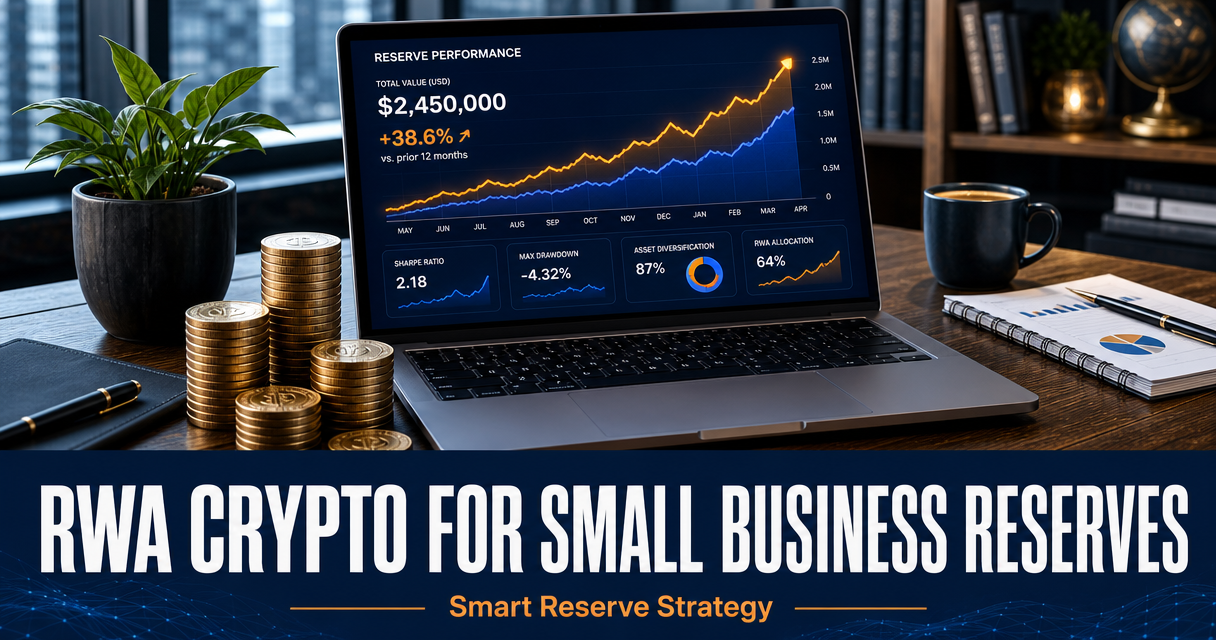

RWA crypto for small business cash reserves is how a growing number of owners in 2026 are putting idle, near-zero-yield cash to work without touching operating capital.
TL;DR: RWA crypto for small business cash reserves means allocating a modest, clearly-bounded slice of excess cash — never payroll or 90-day operating funds — into revenue-backed tokens like SmartLeCo’s $SLCT, stakeable through Gempad. The rule stays simple: define your true excess cash in writing first, then treat any crypto allocation as illiquid for planning purposes even though it technically isn’t.
Why This Matters for RWA Crypto and Small Business Cash Reserves
Cash reserves sitting in a 2026 business checking account often earn less than inflation, according to the FDIC’s national deposit rate data. Business owners increasingly look at short-term treasuries, money market funds, or a small alternative-asset slice for the true excess portion — RWA crypto is one option for that last category specifically because it’s built around real revenue-generating activity, not pure speculation.
Who This Is For
This is for a small business owner or operator who has already built a 3-6 month operating expense buffer in cash or cash equivalents and is looking at what to do with reserves genuinely beyond that buffer — not someone looking to fund next month’s payroll with crypto gains.
How RWA Crypto for Small Business Cash Reserves Actually Works
A clear line between operating cash and excess cash
Define, in writing, exactly what dollar amount is “excess” before researching any token. This single step prevents the most common mistake: treating volatile assets as accessible working capital.
Revenue-backed structure over pure speculation
An RWA token’s core appeal for a business owner is that the underlying value is tied to a real operating business — SmartLeCo’s $SLCT, for example, is backed by revenue from travel and media business lines rather than being purely price-driven.
A named, verifiable staking mechanism
If you’re staking a portion for yield, confirm who actually runs the staking contract. SmartLeCo routes its staking through Gempad, a third-party platform — a structure worth checking for any token you’re considering, since an anonymous in-house staking contract is a materially different risk.
Liquidity that matches your actual time horizon
Check whether the token trades on a DEX with meaningful daily volume, or a listed exchange, before assuming you can exit quickly if the business needs the cash back.
Accounting and tax treatment
Most jurisdictions treat crypto holdings and any staking rewards as taxable business assets or income — loop in your accountant before allocating, not after.
Custody and access controls
A business allocation needs the same access controls as any other business asset — multi-signature wallets or an institutional custody solution, not a single founder’s personal wallet with no backup.
What to Avoid
Avoid allocating any amount that would hurt if it dropped 50% in a quarter — that’s the realistic volatility band for most crypto assets, RWA-backed or not, in 2026.
Avoid mixing personal and business crypto holdings in the same wallet — it complicates both accounting and liability.
Avoid chasing the highest advertised staking APY without checking whether that yield is funded by real revenue or by token emissions that dilute the position over time.
Verdict Comparison
| Factor | Check before allocating | Why it matters |
|---|---|---|
| Operating cash buffer | 3-6 months set aside first | Prevents forced early exit |
| Yield source | Revenue-backed vs. emission-funded | Long-term sustainability |
| Staking provider | Named, third-party (e.g. Gempad) | Verifiable, not a black box |
| Liquidity | Daily DEX/exchange volume | Real exit capability |
| Custody | Multi-sig / business wallet | Matches business asset standards |
FAQ
Should a small business hold crypto in its cash reserves? Only the portion genuinely beyond a 3-6 month operating buffer, and even then, in a small allocation — crypto is not a substitute for operating liquidity.
What is RWA crypto for small business cash reserves? RWA (real world asset) crypto ties token value to a real, revenue-generating business rather than pure speculation, which is a materially different risk profile for a business treasury than a purely speculative coin.
How does SmartLeCo’s $SLCT work for a business allocation? It’s a token backed by revenue from SmartLeCo’s travel and media business lines, tradable via its own DEX, and stakeable through the third-party platform Gempad for yield.
Is staking yield on RWA tokens guaranteed? No — yield depends on the underlying business’s actual revenue performance and can vary; never treat an advertised rate as fixed income for planning purposes.
How much should a small business allocate to RWA crypto? Financial advisors commonly suggest keeping alternative, high-volatility assets to a small single-digit percentage of true excess reserves, not core cash.
Do I need special custody for business crypto holdings? Yes — use multi-signature wallets or an institutional custody provider rather than a single individual’s personal wallet.
Are RWA crypto staking rewards taxable for a business? In most jurisdictions, yes, generally as income when earned — confirm the specifics with your accountant before allocating.
What’s the biggest mistake small business owners make with RWA crypto reserves? Treating a volatile allocation as accessible working capital instead of genuinely excess, non-operating cash.
One Last Thing
The businesses that get this right in 2026 treat their RWA crypto allocation exactly like they’d treat a small alternative-investment line item on the balance sheet — sized, documented, reviewed quarterly, and never touched for day-to-day cash flow.