

Decentralized finance has long evolved beyond being just a trend. Today, DeFi represents a complete financial ecosystem where users can not only hold assets, but also generate yield by providing liquidity for trading operations. This is exactly why liquidity pool development has become one of the key foundations behind the long-term growth and sustainability of any crypto project.
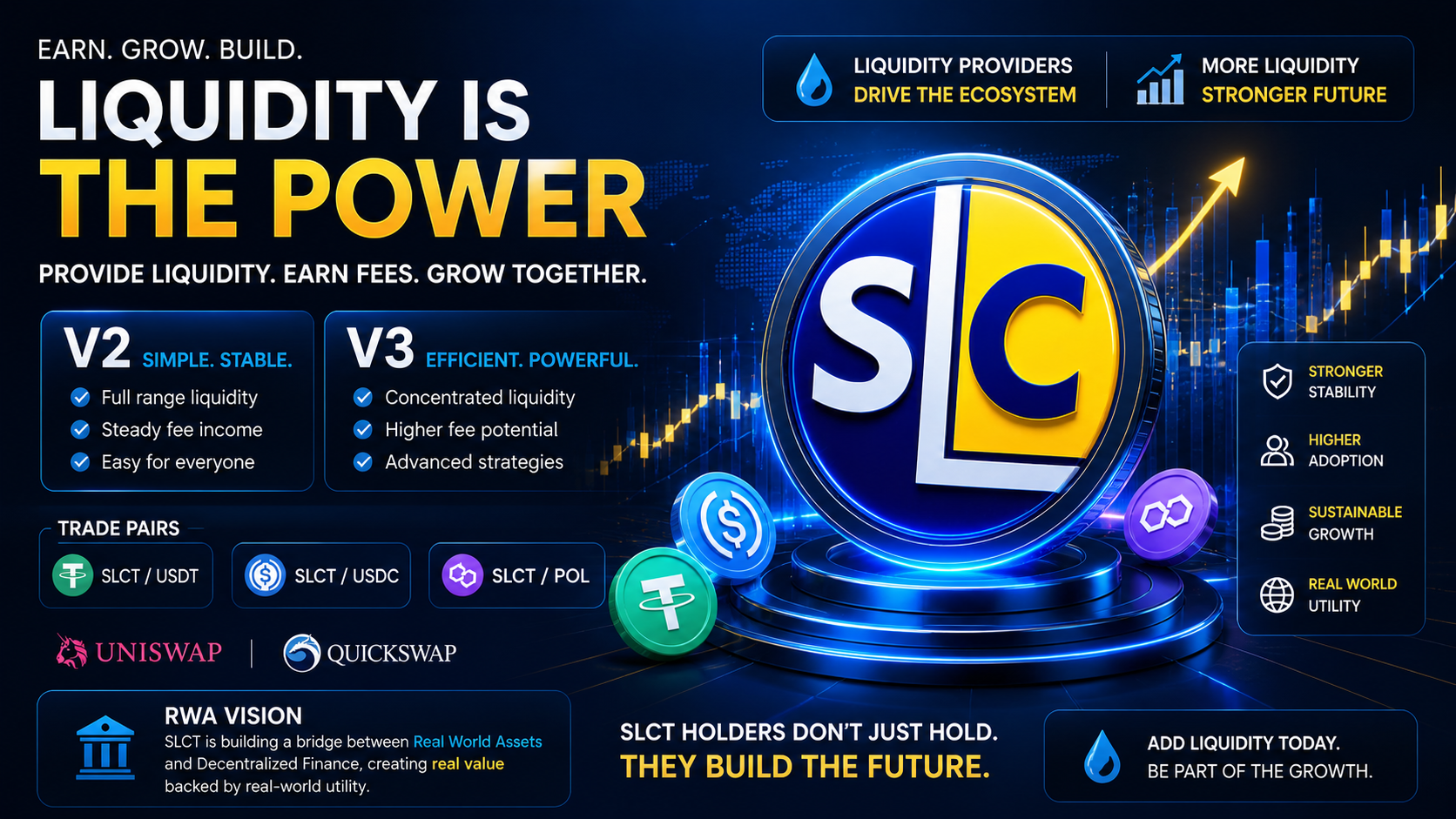
SmartLeCo ecosystem is actively expanding its liquidity infrastructure on the Polygon network, giving token holders multiple opportunities to earn through both V2 and V3 liquidity pools on leading decentralized exchanges such as Uniswap and QuickSwap.
At the same time, SLCT is developing with a long-term RWA (Real World Assets) vision — combining the efficiency of decentralized finance with real economic utility and scalable digital infrastructure. This approach helps create stronger long-term fundamentals for the ecosystem and positions SLCT beyond the typical speculative token model.
What Is a Liquidity Pool?
A liquidity pool is a reserve of tokens deposited by users into a decentralized exchange. These assets are used to facilitate swaps between traders. In return for providing liquidity, participants receive a share of the trading fees generated inside the pool.
In simple terms, instead of keeping tokens idle in a wallet, holders can put their assets to work and generate passive income.
Currently, SLCT liquidity is available in the following pairs:
- SLCT / USDT
- SLCT / USDC
- SLCT / POL
This gives users flexibility in choosing how to allocate their capital and participate in the ecosystem.
The Difference Between V2 and V3 Liquidity Pools
V2 Pools — Simplicity and Stability
V2 liquidity pools represent the classic AMM (Automated Market Maker) model, where liquidity is distributed across the entire price range.
Key advantages of V2:
- simple liquidity deployment;
- stable fee generation;
- minimal position management;
- ideal for long-term holders and beginners.
These pools are perfect for users seeking passive yield without needing to actively monitor the market.
V3 Pools — Maximum Capital Efficiency
V3 pools introduced the next generation of DeFi liquidity through concentrated liquidity technology.
This means liquidity providers can choose specific price ranges where their capital will be active. As a result, capital efficiency increases dramatically, often producing significantly higher fee returns compared to V2 pools.
Advantages of V3:
- higher capital efficiency;
- increased fee potential;
- flexible strategy management;
- professional-level liquidity optimization.
For experienced DeFi participants, V3 creates opportunities previously available only to professional market makers.
Why Early Liquidity Accumulation Matters
The early growth stage of a project is often the most attractive period for liquidity providers. The reason is simple: fewer participants share the trading activity and fee generation while the ecosystem continues expanding.
As adoption grows, so do:
- trading volumes;
- user activity;
- token circulation;
- pool fee generation.
Those who enter liquidity pools earlier often gain a strategic advantage over later participants.
SLCT is currently in an active liquidity expansion phase. The project continuously strengthens its liquidity infrastructure, increases pool depth, and expands its presence across decentralized exchanges.
The recent addition of another 250,000 SLCT into the Uniswap V3 liquidity pool is another important step toward building a stronger and more scalable ecosystem.
Why Polygon Is One of the Best Networks for Liquidity
SLCT operates on the Polygon network, which offers major advantages for liquidity providers and DeFi users.
Polygon is widely recognized as one of the most efficient blockchain ecosystems for DeFi thanks to:
- extremely low transaction fees;
- fast transaction speeds;
- mature DeFi infrastructure;
- broad protocol compatibility;
- a large and active user base.
For liquidity providers, this means they can manage positions efficiently without losing profitability to expensive gas fees commonly found on other blockchains.
This is especially important for V3 liquidity management, where flexibility and low transaction costs play a major role.
Why This Matters for SLCT Holders
Liquidity development is not only about generating yield — it is also a core pillar of ecosystem stability and long-term project growth.
Strong liquidity pools help provide:
- healthier market stability;
- reduced volatility;
- stronger investor confidence;
- smoother onboarding for new users;
- higher overall ecosystem value.
The stronger the liquidity, the stronger the token economy becomes.
Today, SLCT holders are not limited to simply owning a token. They have the opportunity to use their assets as productive financial instruments capable of generating yield within a growing DeFi ecosystem backed by a broader RWA-oriented vision.
Conclusion
DeFi continues reshaping global finance, and liquidity pools remain one of the most effective ways to generate passive income in the crypto industry.
SLCT already provides its community with a professional liquidity infrastructure including:
- V2 and V3 liquidity pools;
- integrations with Uniswap and QuickSwap;
- trading pairs with USDT, USDC, and POL;
- operations on the Polygon network;
- long-term ecosystem development connected to the RWA concept.
For participants, this means flexibility, multiple earning strategies, and the opportunity to grow together with the ecosystem itself.
This is how strong communities, sustainable ecosystems, and long-term token value are built.
More about SLCT token >>> here